The nitrogen vacuum sintering furnace is a heat treatment equipment that integrates vacuum degassing, nitrogen inert atmosphere protection, and high-temperature sintering. First, evacuate the binder and impurity gases inside the billet, then fill it with high-purity nitrogen to create an oxygen free protective environment, avoiding oxidation and decarburization of the workpiece at high temperatures, improving material density and product stability. It is widely used in sintering production and scientific research experiments in the three major fields of powder metallurgy, advanced ceramics, and magnetic materials.
 Regular maintenance of the vacuum furnace is also an important means to reduce malfunctions
1. Application of Powder Metallurgy Material Sintering
Powder metallurgy is the mainstream application direction of nitrogen vacuum sintering furnace. Metal powder compacts are prone to oxidation during high-temperature sintering, and vacuum pre degassing can remove internal pores in the powder and decompose binders such as paraffin and plastic inside the billet; Inject nitrogen to maintain an inert atmosphere, ensuring that metal particles undergo atomic diffusion and densification in a pure environment.
Applicable materials: MIM metal injection molded parts, hard alloys, stainless steel powder parts, tungsten molybdenum refractory metals, iron-based alloys, etc.
Industry uses: mechanical cutting tools, automotive parts, medical device accessories, wear-resistant parts.
Process advantages: reduce product porosity, improve mechanical strength of parts, clean surface of finished products, and reduce subsequent polishing processes.
2. Application of Ceramic Material Sintering
Many precision ceramics undergo chemical reactions when exposed to oxygen in high-temperature environments, directly causing cracking and performance degradation. The nitrogen vacuum sintering furnace can adopt a vacuum+nitrogen composite atmosphere sintering according to the ceramic formula, control the partial pressure inside the furnace, ensure the uniform growth of ceramic grains, and improve the density, bending strength, and insulation performance.
Applicable materials: alumina ceramics, silicon nitride ceramics, zirconia ceramics, silicon carbide ceramics, piezoelectric ceramics, electronic ceramic substrates.
Industry applications: semiconductor ceramic components, ceramic cutting tools, high-temperature resistant structural components, sensor ceramics, ceramic atomization cores.
Process advantages: Uniform temperature field, effectively reducing product warping and deformation, suitable for small batch research and development of precision ceramics to industrial mass production.
3. Application of magnetic material sintering
Magnetic materials such as neodymium iron boron and ferrite, once oxidized at high temperatures, will directly cause a significant decrease in magnetic properties. The nitrogen vacuum sintering furnace provides a low oxygen nitrogen protective atmosphere, purifies grain boundary impurities during sintering, stabilizes crystal structure, and ensures the stability of key indicators such as material magnetic energy product and coercivity. It is the core equipment for the production of high-performance permanent magnet materials.
Applicable materials: neodymium iron boron permanent magnet, samarium cobalt magnet, manganese zinc ferrite, nickel zinc ferrite.
Industry applications: New energy motors, sensors, speakers, nuclear magnetic resonance equipment, electronic components.
Process advantages: controllable atmosphere, reduced magnetic oxidation failure, and better consistency of magnetic properties among batches of products.
4. General process advantages of nitrogen vacuum sintering furnace
(1). Flexible atmosphere switching: supports vacuum degreasing and debonding first, followed by nitrogen protection sintering, and can set segmented atmosphere and segmented heating curve.
(2). Strong sealing: The flange sealing structure has a low leakage rate and maintains a stable low oxygen environment.
(3). High temperature control accuracy: Multi zone independent temperature control, uniform temperature field, meeting the requirements of gradient heating and constant temperature insulation for material sintering.
(4). Widely applicable scenarios: Small laboratory models, pilot equipment, and industrial continuous production models can all be customized according to non-standard requirements.
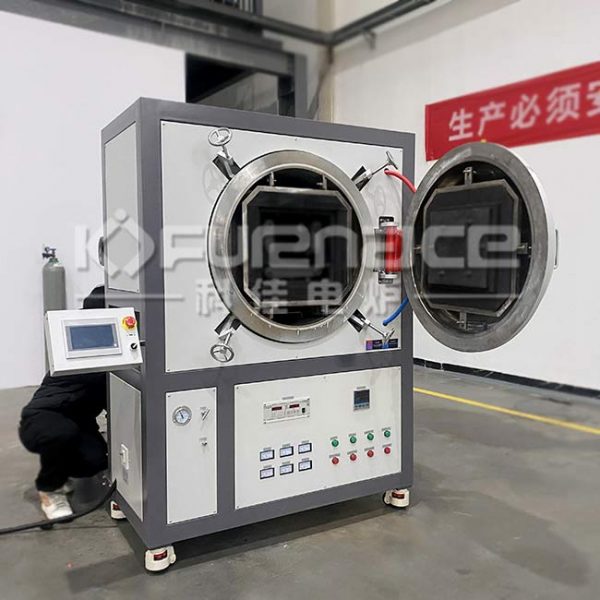 KJ-VS1700-12CWG vacuum sintering furnace (click on the picture to view product details)
5. Selection Tips
To purchase a nitrogen vacuum sintering furnace, it is necessary to confirm the maximum operating temperature, ultimate vacuum degree, nitrogen supply system, and furnace material based on the material type. For example, some ceramic materials should pay attention to whether nitrogen will react with the substrate, and if necessary, replace the furnace material or adjust the process curve. At the same time, priority should be given to manufacturers with complete after-sales service and stable supply of accessories to ensure long-term production and stable operation.
Click to learn more customized vacuum furnaces! Or
click on online customer service to learn more about product information!
FAQ
Q: What is the difference between nitrogen vacuum sintering and pure vacuum sintering?
A: Maintain negative pressure throughout the entire process of pure vacuum sintering; Nitrogen vacuum sintering is a process of "vacuum debonding+nitrogen protection sintering". Some materials are prone to element volatilization under high vacuum, and introducing nitrogen can suppress element volatilization, stabilize material components, and reduce product waste rate.
Q: Can laboratory small samples be sintered in a nitrogen vacuum furnace?
A: Okay. The equipment has small desktop models, suitable for research and development by universities and new material enterprises, and can be used for sintering tests on a small number of samples.
If you need a nitrogen vacuum sintering furnace for powder metallurgy, ceramics, and magnetic material sintering, you can call to inquire about equipment parameters and customized solutions.

 English
 简体中文
 Français
 日本語
 한국어
 Português
 Русский
 Español